
A model for motion
Below follows a thought experiment, accompanied by drawings/animations. The drawings/animations are merely artistic renditions (not technical drawings) and are vastly exaggerated to get the point accross.
Part 1: Virtual substance
Suppose that the observable universe is an after-effect of a substance with certain
properties. The after-effects form objects within the substance and objects
cannot interact with the substance itself. Because the objects within the substance
are mere after-effects, they cannot interact with the substance. As such, the
substance shall be referred to as 'virtual substance' ("VS" or "VS model").
VS has at least the following two properties:
              1. The VS is under tension: it can be warped / twisted,
              but VS resists and it always has the tendency to return to
              its original state.
              2. There is a maximum rate at which VS can be warped/stretched,
              whereby the more VS is stretched, the more it resists,
              and the longer it would take to return to its original state.
The 'time' aspect of the model can be measured outside of the VS model. It should
be considered that the twists within the model experience 'time' based on spin cycles.
The twists can be stretched as a consequence of the VS properties and therefore a
cycle can take longer/shorter depending on the stretch. The twists in the VS model
can experience 'time' differently from one and other due to this stretching effect.
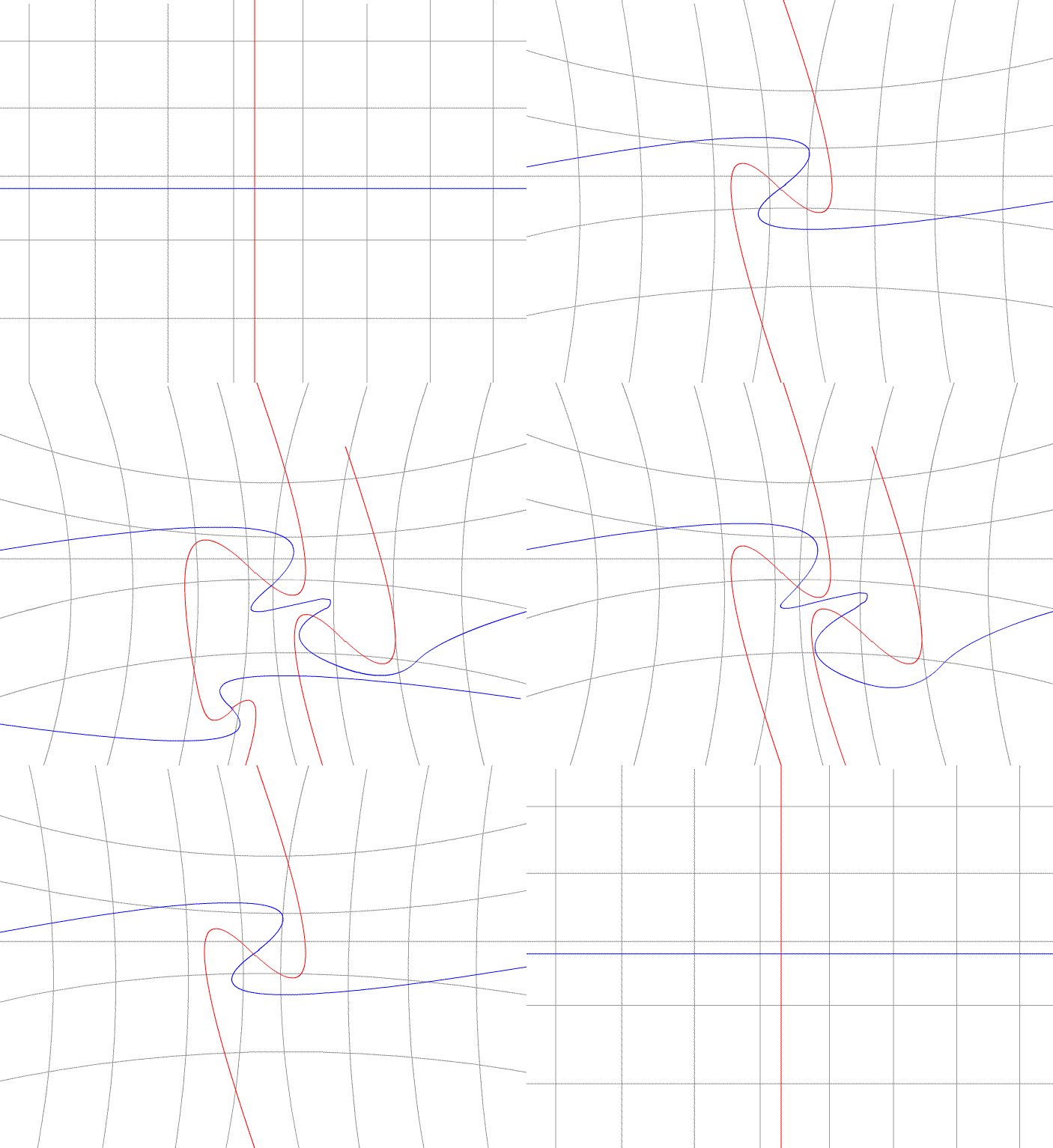
Below follows an animation of a warp in VS when one or several areas within VS would 'twist'. Red/blue colored lines represent X/Y axes within VS, whereas the grey grid is a 2d representation of VS.
In quantum physics, the spin property is one of the measurable properties of particles. In the next segment, the spinning motion is further explored and applied to the VS model.
Part 2: Motion: spinning twists gliding through a virtual substance?
What happens when twists in VS (hereinafter referred to as VS objects) perform the 'dirac'
spinning motion?
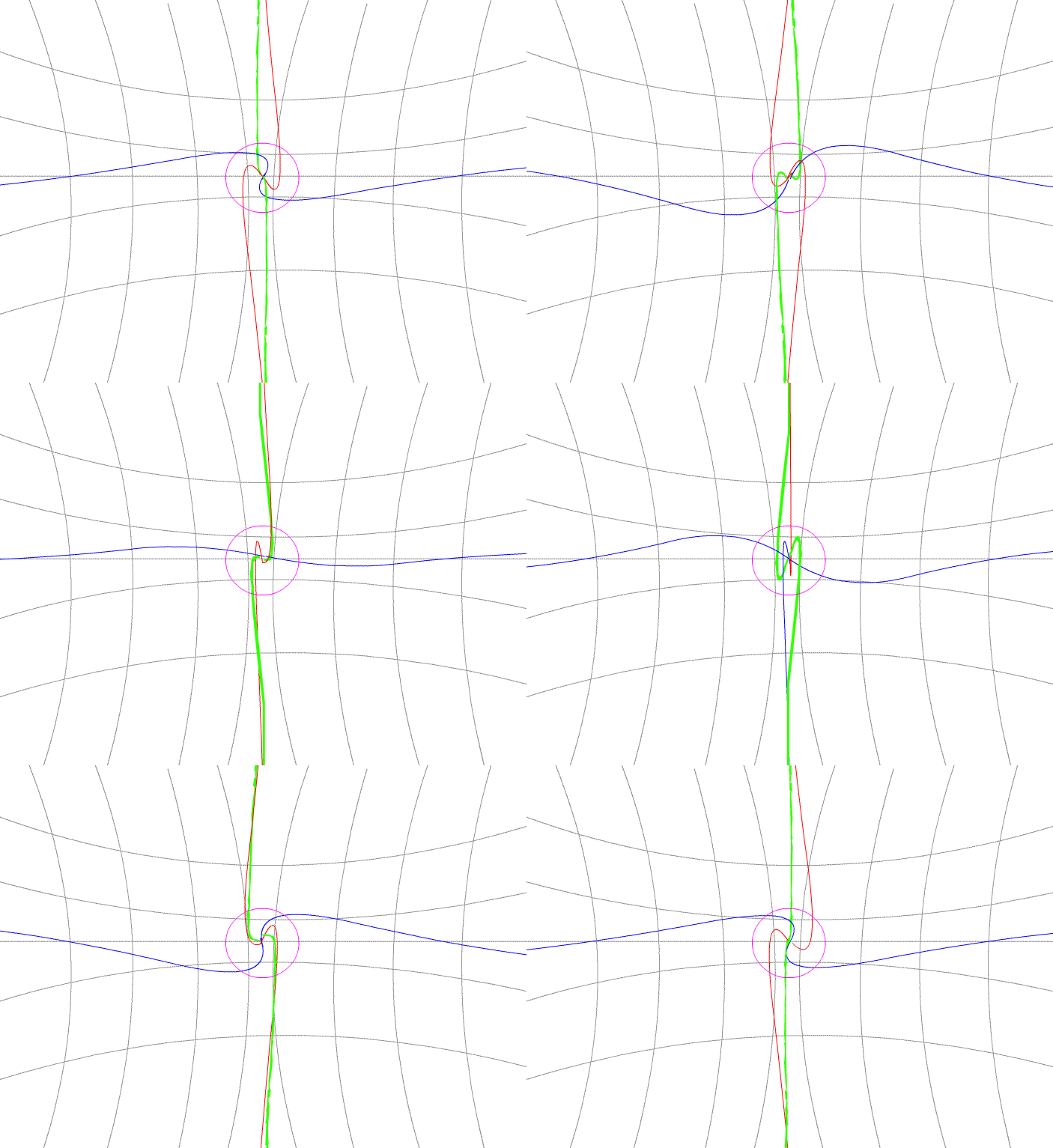
The tension applied by VS leads to tether-like behavior at the epicenter of the
twist. The knots/twists produce an outward omni-directional warping effect in VS.
In the VS model, the spin property could potentially form the fundamental
principle for motion. Suppose that the origin of the spin of a particle is not
perfectly centered within the VS warp caused by the VS twist itself.
Would the disbalance of tension cause the origin of the spin to shift, as the
spinning torrent is unable to reach equilibrium?
A hand drawn animation follows (motion from left to right; magnetic effects are left out for simplicity):
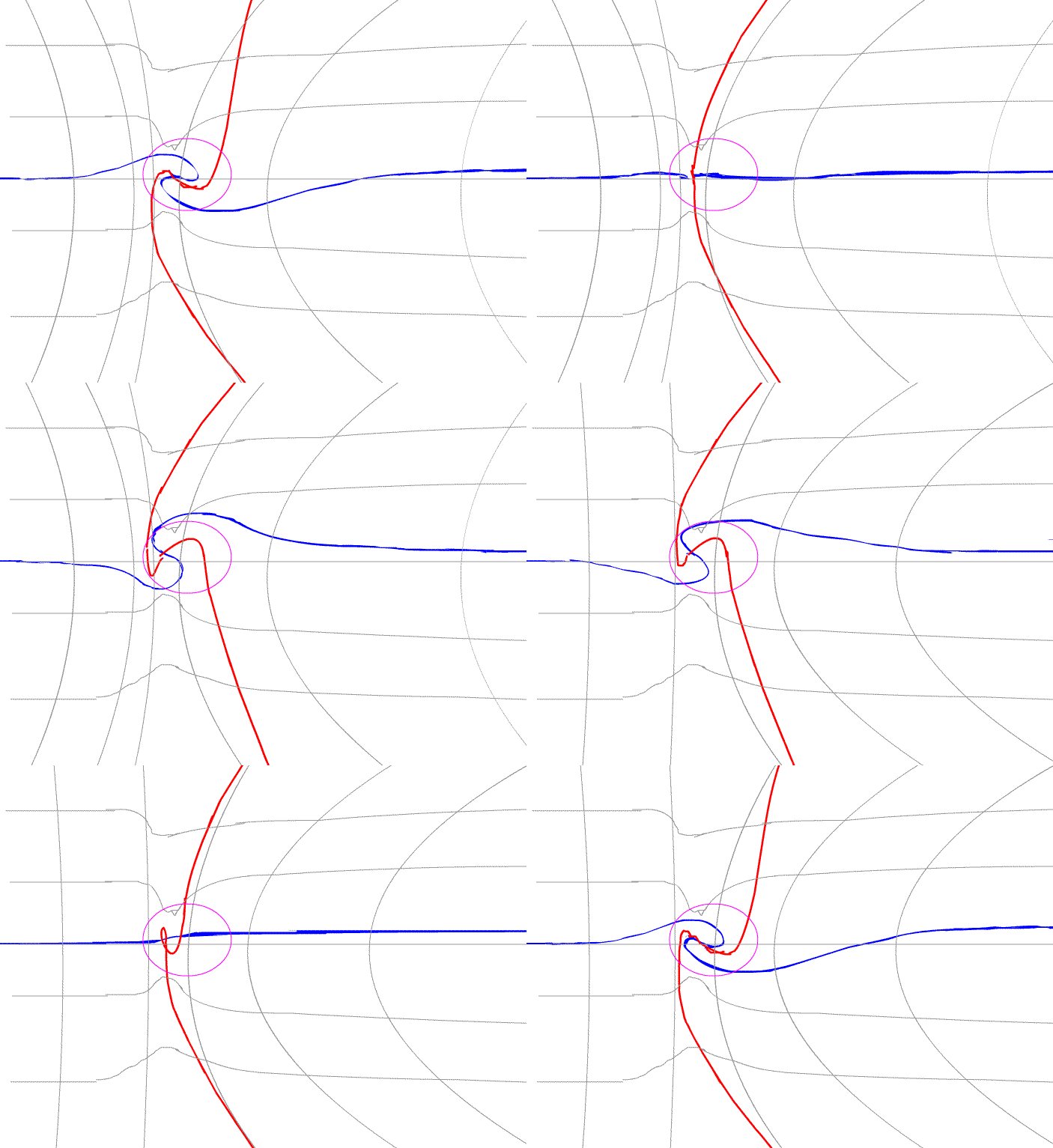
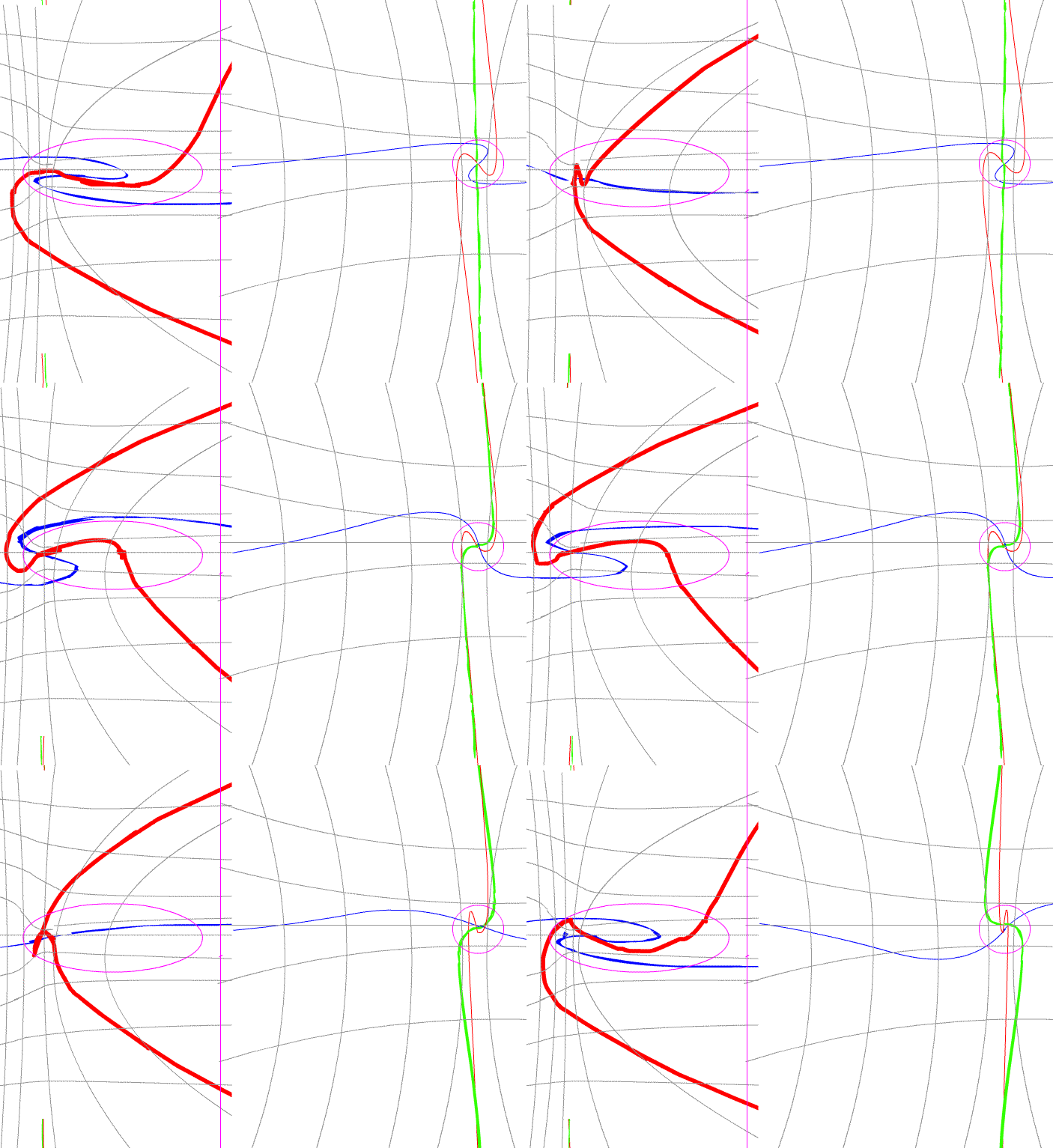
As the origin of the spinning motion shifts within its own distortion, tension and the warping
effect intensify, and the VS warp has a larger area of effect. The particle glides within VS like
a wave. Though the object warps a larget portion of VS, within the observable universe of the VS
objects themselves, quantity/size/warping of VS cannot be observed. Only the causal after-effects
are observable.
The position of the origin of the twist effects how strong the VS warping effect is and the level
of tension. The stronger the warping effect, the larger the portion of VS traverersed for each full
spin sequence.
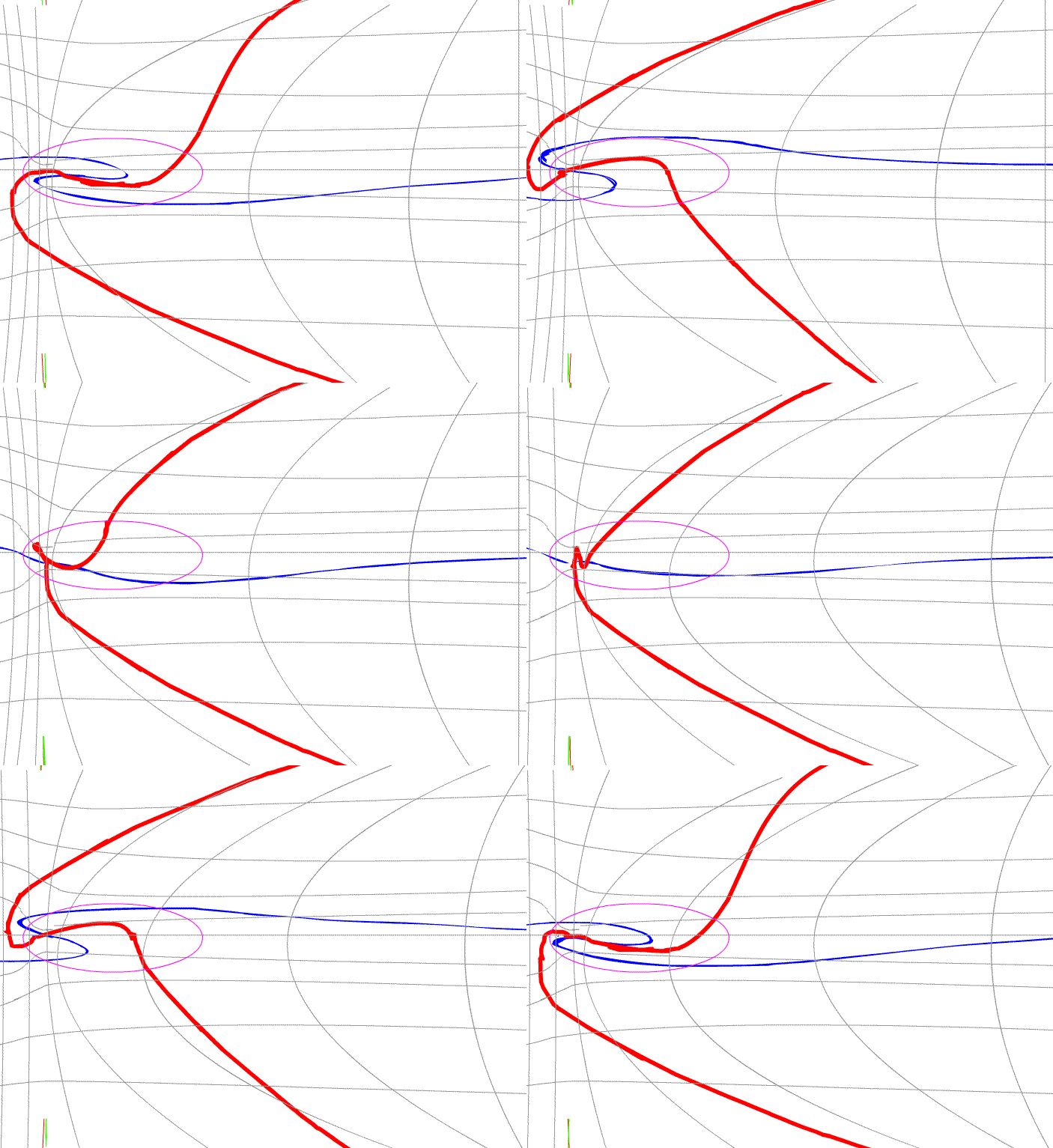
In other words, the frequency of the spin of a moving VS object is lower compared to the frequency of a stationary spinning VS object:
Assuming that the above approach would apply to real world objects such as fermions, this
would imply that the spin frequency of fermions decreases with increased velocity.
Interestingly, in their 2014 paper, Bruschi et al propose that acceleration and gravity
degrade entanglement, implying that spin could be affected by gravity and acceleration:
                David Edward Bruschi et al 2014 New J. Phys. 16 053041 NJP link


                Recently, it has been shown that the entanglement between
                field modes of localized systems, such as cavities, is
                sensitive to changes in acceleration [18]. Via the equivalence
                principle, this means that entanglement should, therefore,
                be affected by changes in gravitational field strengths.
                We propose to demonstrate this experimentally by considering
                the entanglement between the excitations of two Bose–Einstein
                Condensates (BECs), each one of them prepared in a separate
                satellite. The BEC excitations we consider are known as
                quasiparticles or phonons. These excitations obey, under
                certain circumstances, a massless Klein–Gordon equation with
                a very slow speed of propagation [19]. Low propagation speed
                is the key element to enable the observation of the effect we
                describe below within realistic experimental regimes. We
                propose to entangle two BEC modes, one in each BEC, while the
                BECs move close to each other along the same circular Earth
                orbit. One of the satellites will then undergo non-uniform
                motion to change to an orbit subject to a different
                gravitational field strength (see figure 1). Our analysis
                shows that the entanglement degradation between the BEC modes
                is a periodic function of the change in gravitational field
                strength in the orbit. This effect is already significant
                for typical parameters involved in microsatellite manoeuvres,
                which is a great advantage since experiments involving such
                satellites have relatively low costs.
Part 3: one principle for motion, with two methods of acceleration?
In the VS model, all movement of objects is explained by spin and VS warp. Acceleration/deceleration, however, comes in two categories: 'collision based' and 'passive'.
'Proximity' acceleration (deceleration)
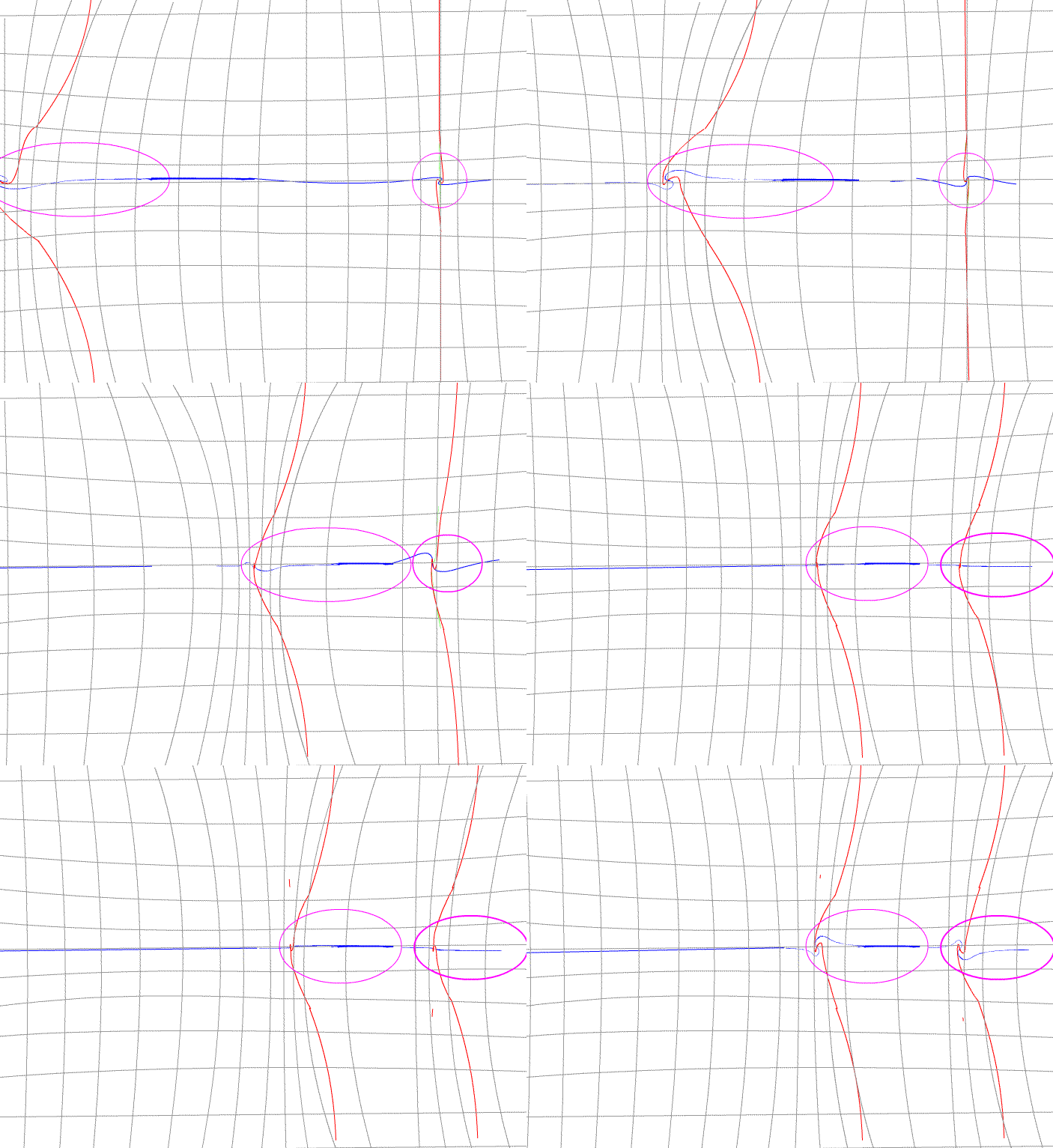
Suppose a VS object would move towards a stationary VS object. Eventually the two would come
in close proximity. The VS warping effect of the moving and stationary particle would start
to overlap. The two warping effects would start to 'tug'. During this violent encounter, the
VS objects would synchronize their spin as the objects start to compete for the same chunk
of VS in a tug of war. During the 'tug of war', parts of the VS warping effect caused by the
moving object is is transferred during the collision, until both move (spin starts to
'synchronize' during the process).
When a cluster of VS objects is in close proximity, each VS object could 'tug' the other into
place in a synchronized spin motion, creating a stable construct. If the construct is too
unstable, the VS objects would disperse.
Animation:
'Passive' acceleration
The warping effect of a stationary VS object reaches outward in all directions.
In case many VS objects are located in a very close proximity to one and other,
creating a massive VS object, the omni-directional VS warping is amplified.
Suppose a single VS object comes into close proximity to a masss (both initially
stationary). The two VS warping effects would overlap. Due to the vS warping effect
of the massive object being stronger, the center/origin of the spin of the single
VS object would become disproportionally warped, causing that object to move:
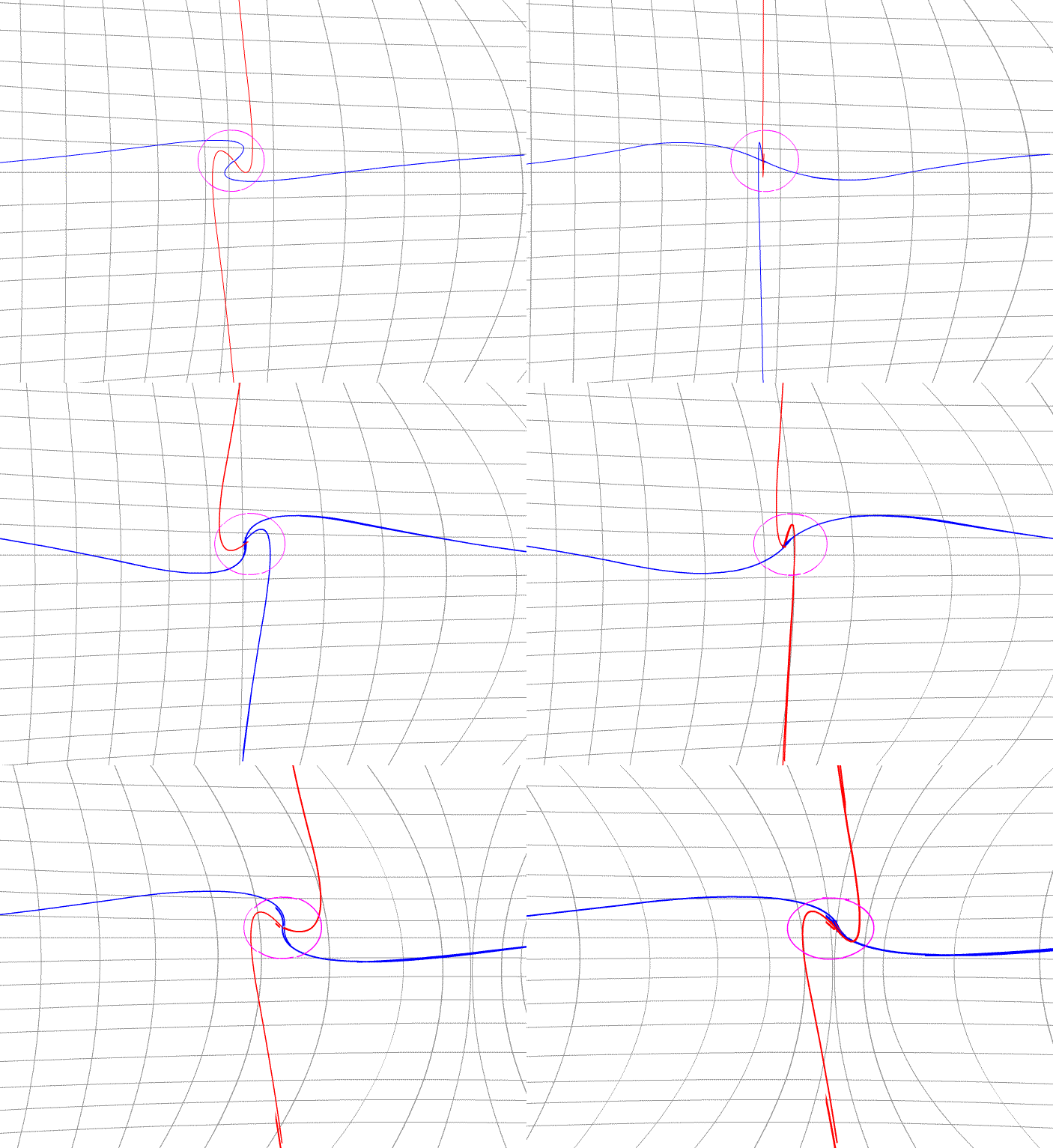
The warping effect created by the mass reaches outwards gradually. The VS object gradually propels itself towards the mass. The VS warping effect is stronger at the center. The VS object is warped gradually as it moves towards a mass. Once the surface of the mass is reached, the VS object and the mass start the 'tug of war'. The VS warping effect of the VS object is reduced until the origin of the VS object stops moving, though the tug of war effect never stops: the VS object has the dendency to propel itself towards the center, but is kept from doing so by the constant tug interaction with the VS objects within the mass.
Combinations of Passive and proximity acceleration
Suppose an accelerated particle is moving within a gravitational field. Upon
accelerating, inertia applies (the tug of war). However, upon bleeding energy
to a VS warping effect (gravitational field), inertia does not apply.
In the VS model, this could be explained by overlapping VS warp effects of
the moving VS object (particle) and the stationary construct of VS objects
(the mass).
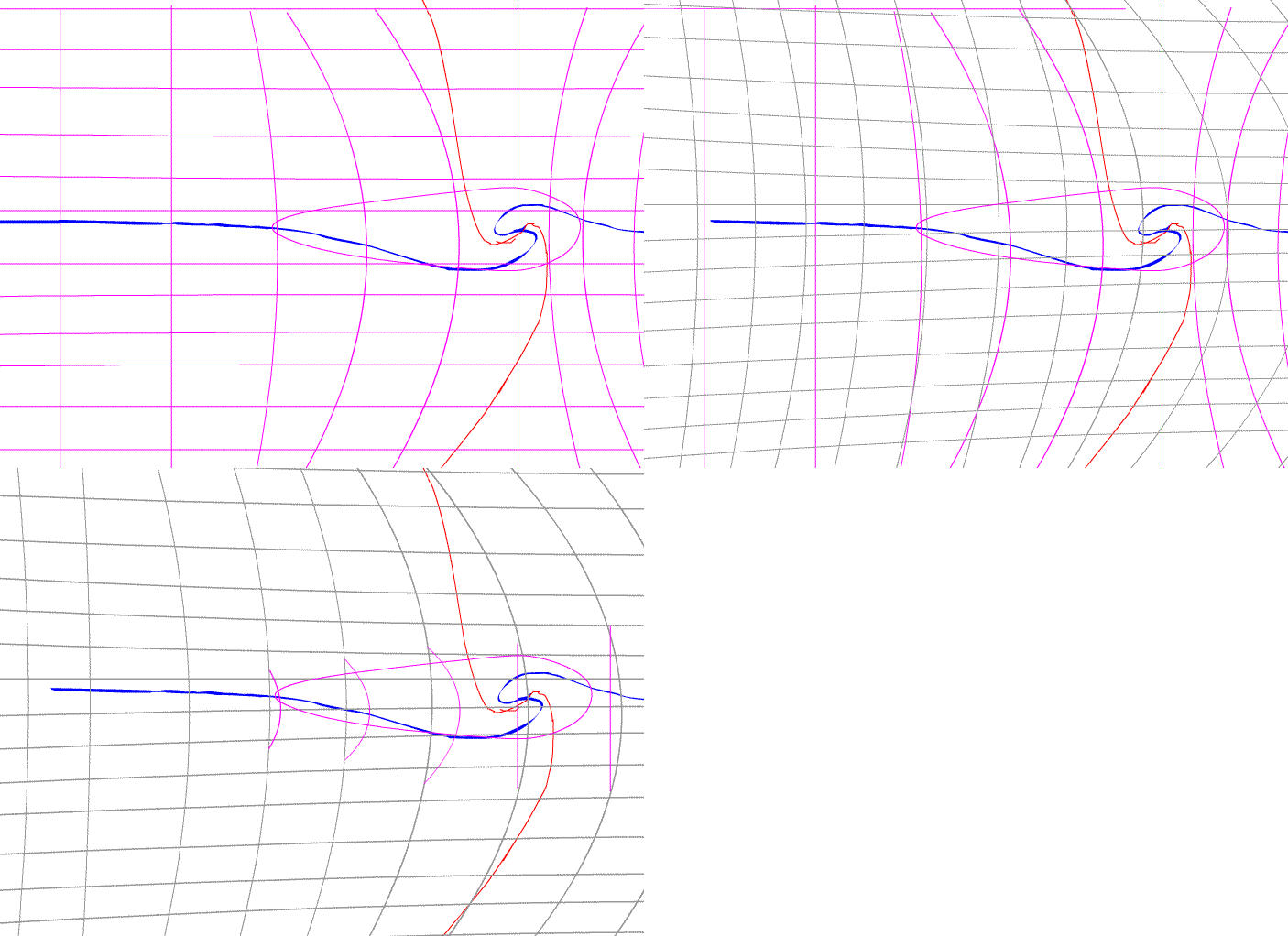
Pink is the VS warping effect produced by the moving particle, whereas grey is the omni-directional warping effect produced by the massive object. The VS warp effects overlap, resulting in the moving particle to 'passively' lose its warping effect on VS ('bleeding' energy to the gravitational field).
Suppose a particle is travelling at a certain velocity in the oposite direction of a source of gravity. The object bleeds energy to the gravity source and loses velocity (simplified animation of the warping effects within VS):
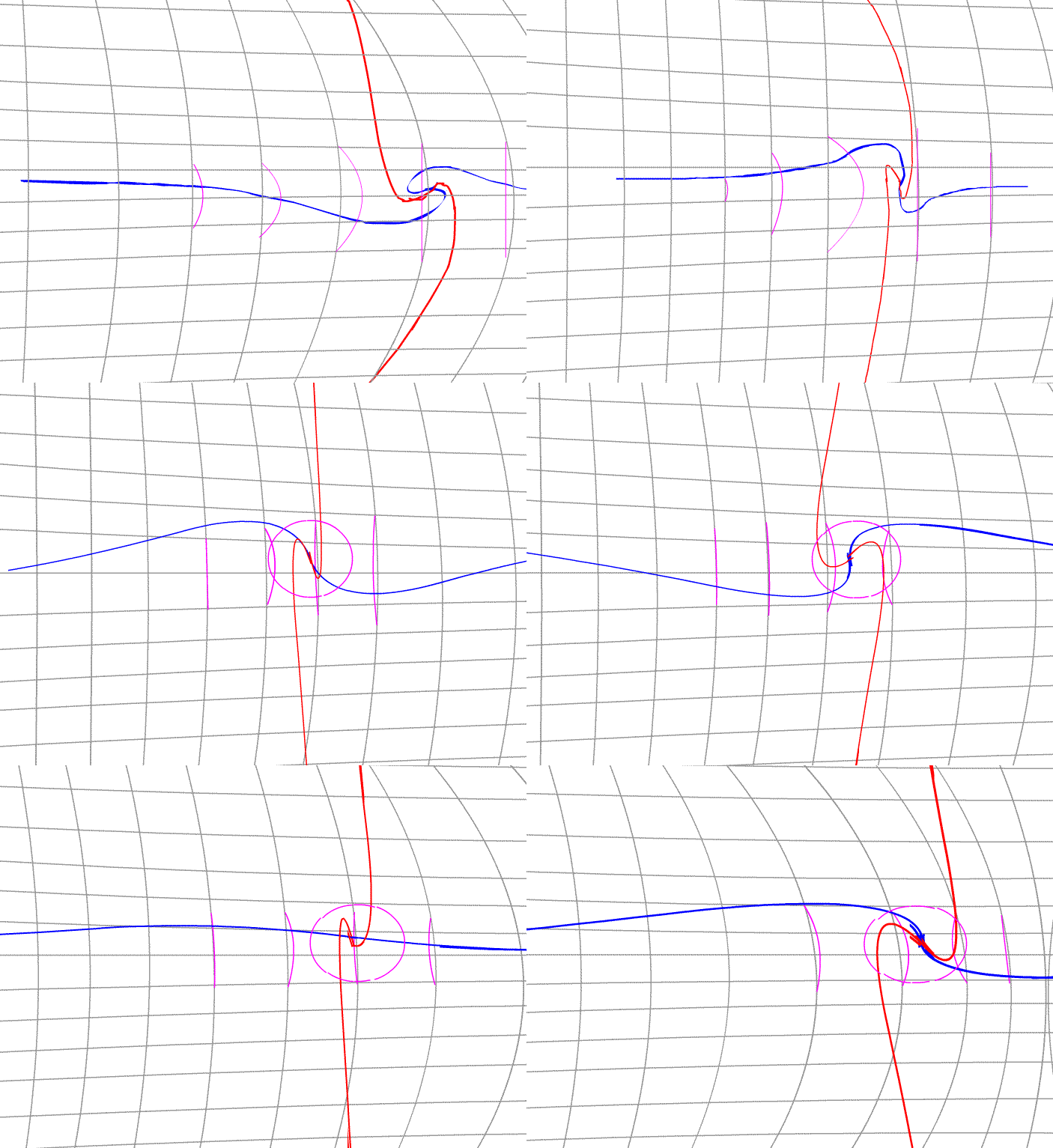
The VS warping effect created by a particle 'bleeds' passively, until the VS object loses all velocity. The VS object then accelerates passively towards the massive object, until the tug of war ocurs upon close proximity with the mass.
Part 4: Mass?
Why is the surface of a massive object exhibiting the same properties as
an accelerating object while remaning stationary? Why is the surface of the
massive object accelerating without the constant need for energy? Where
is all this power coming from? Why do force of inertia not apply to gravity
related acceleration?
In the VS model, mass is a bundle of VS objects, which warp VS and keep
each other in place through a constant tug of war. As the mass particles
are 'thethered' and keeping each other in place, these objects create a base
VS warping effect in stationary position.
Hand drawn animation (left stationary mass, right moving particle):
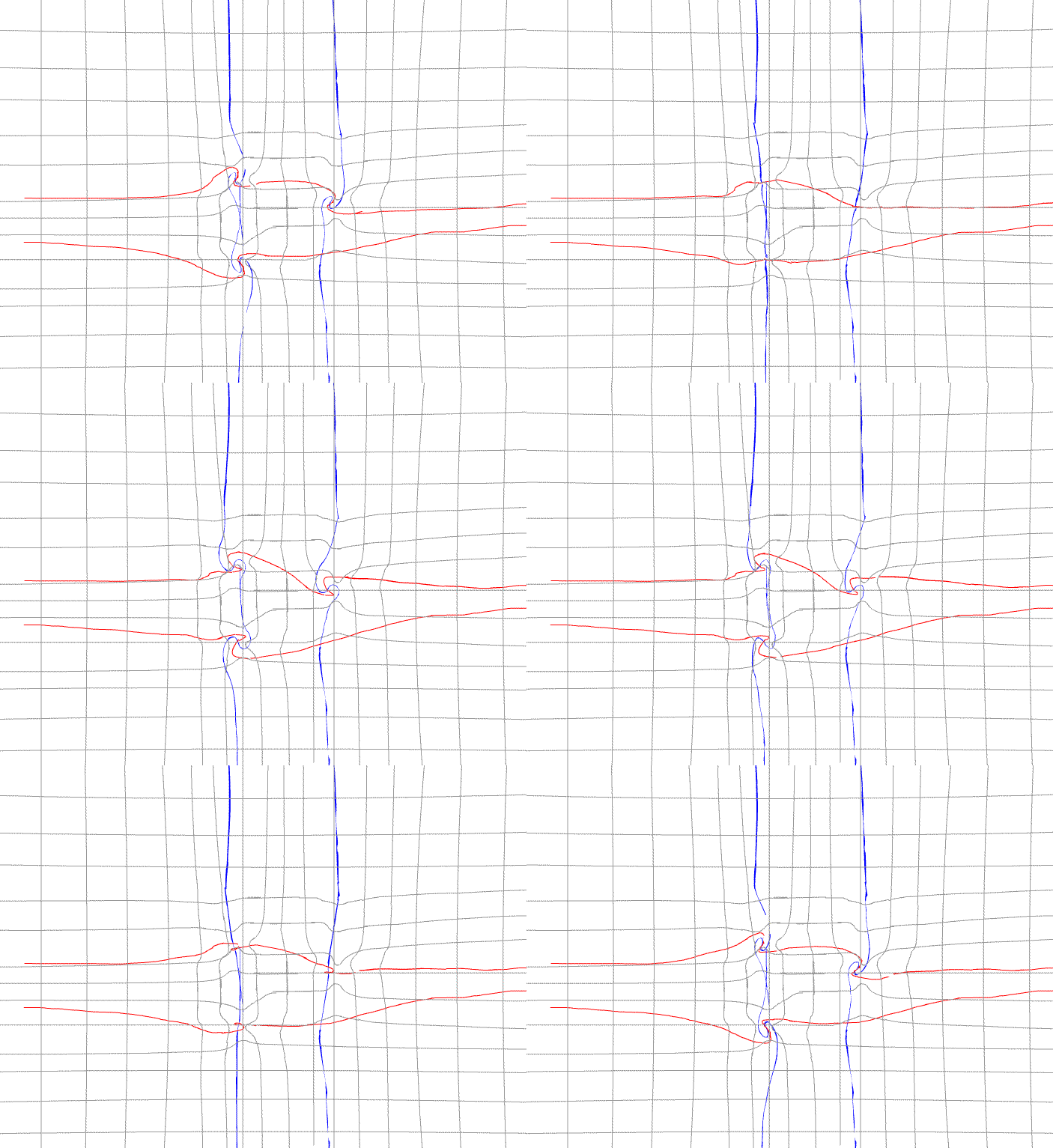
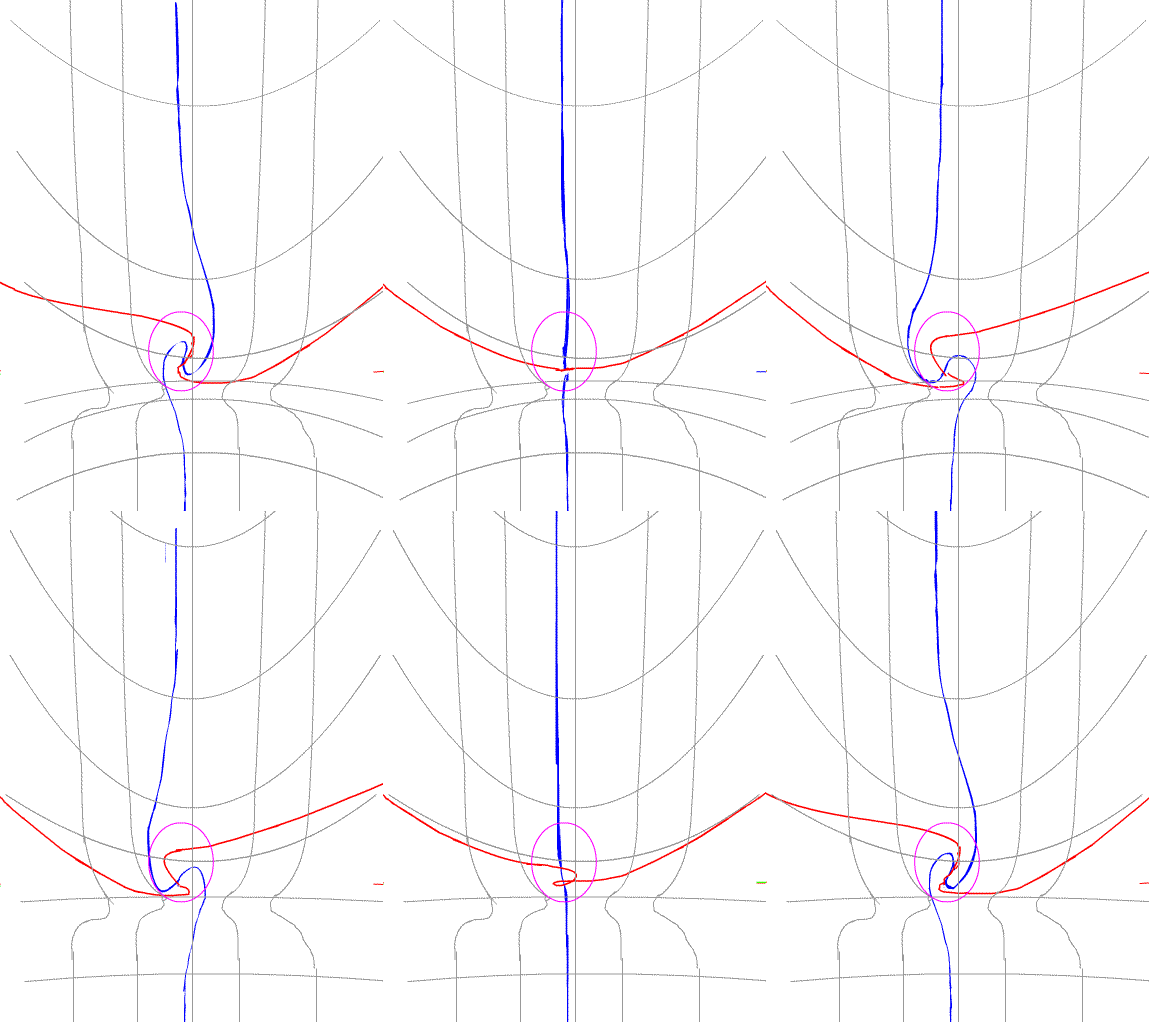
Particles moving at a steady velocity create a VS warping effect, similarly
to the VS warping effect created by a massive object at its surface. A
single moving VS object is, however, not tethered to other VS objects and
therefore loses in a tug of war with a bundle of tethered VS objects.